Simon Kefas
The SonSimon Kefas is a senior Oslo police officer, a husband and father, and the longtime friend whose secret betrayal lies at the heart of the police-mole mystery. His career and intimate loyalties collide when he admits that he was the mole who served the Twin, then asks Sonny Lofthus to help expose the criminal partnership Simon once protected. His arc turns on the distance between knowing what justice requires and having the courage to act on it.
Identity and Background
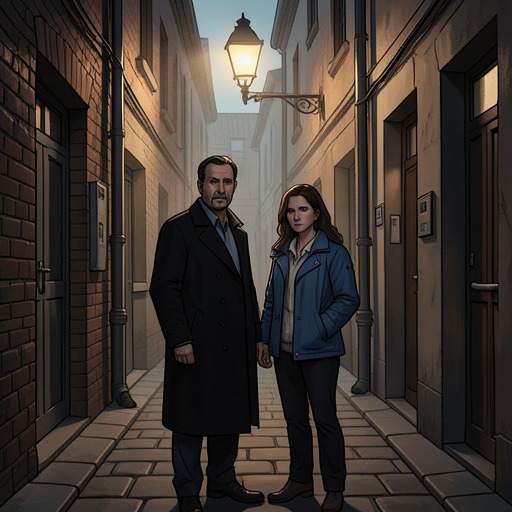
Simon is introduced at home in Fagerliveien, in the Oslo neighbourhood of Disen, with coffee at the kitchen table and a small garden visible from the house. The thinning hair and the prospect of mowing the rain-bright lawn place him within ordinary domestic routines, while his answer to his wife Else about why he does not buy an electric mower—money—links his present life to a household economy in which finances once ended discussions. He remembers the neighbourhood as a place of teachers, hairdressers, taxi drivers, public-sector employees, and police officers; its newer residents, among them people in advertising, information technology, journalism, and medicine, have helped raise house prices and shifted its social character. The domestic detail makes Simon’s later entanglement with large-scale money laundering feel less like an abstract crime than a corruption reaching into the life of a man who has long measured ordinary choices against what a household can afford.
Simon is a police officer nearing retirement, though the novel also identifies him as a former investigator with the Serious Fraud Office. In the course of the investigation, he explains to Kari Adel that he had uncovered a money-laundering operation involving substantial sums and powerful suspects. Senior colleagues regarded the inquiry as a danger: they feared that the police lacked enough evidence to secure a conviction and would suffer a backlash even if they prevailed. Simon presents the decision to stop pursuing it as institutional self-protection, not as a dispute over an ordinary criminal case. His account shows how the same legal system used to investigate wrongdoing can become a means by which influential suspects threaten those investigating them.
Career and the Mole Mystery
When Simon explains the old rumours of a police mole to Kari, he describes a traitor who leaked information to the person controlling much of Oslo’s drug and sex-trafficking activity. At the time, there was much talk but no publicly established proof that either the mole or the criminal figure existed. Simon identifies that figure as the Twin and, when Kari asks how he knows, answers that the Twin was his best friend. The revelation changes the mystery’s emotional scale: Simon’s knowledge is not merely professional intelligence about an elusive criminal, but knowledge rooted in personal allegiance.
The police had concluded that Ab Lofthus was the mole. Simon says that when Ab died, the apparent consequences stopped: raids no longer failed in the same way, and evidence, witnesses, and suspects no longer seemed to disappear. The officers treated this change as proof. Yet Simon insists that there really was a mole, while also describing Ab as proud of his work and the police force, uninterested in getting rich, and devoted to his family. The contrast separates the apparent resolution of the old case from its truth. The force’s inference rested on the timing of events; Simon’s account points to a hidden betrayal that the presumed culprit’s death could not explain.
Simon’s investigation method includes a deliberate change of viewpoint. At one point he tells Kari that changing perspective and location can compensate for blind spots. Considering the evidence of a shooting in an elevator, he states that at least one shot was fired inside the lift. The practical inference reflects a broader habit: he treats a scene not as a fixed picture but as something that may look different from another position. The principle is also an apt description of his own story, in which the visible career of a police investigator conceals a role that can only be understood by revisiting the past from another angle.
The Criminal Network and Its Evidence
Simon connects the Twin to a broader arrangement between criminal activity and respectable business. Confronting Iver Iversen, he says that Iversen Property had done business with the Twin, laundering money from drug dealing and trafficking while receiving fictitious losses that enabled tax savings amounting to hundreds of millions of kroner. Iversen denies knowing the Twin, but Simon says he has evidence that they worked together. The confrontation enlarges the mole mystery beyond a single leak: information, criminal proceeds, and commercial cover are joined across institutions, and the police investigation must contend with people who can use established systems to protect themselves.
The novel’s account of Simon’s own complicity becomes explicit through Ab Lofthus’s diary. It records that two corrupt officers had turned a blind eye to drug dealing, human trafficking, and murder, and that the pair’s arrangement exploited the Twin’s assumption that he had a single police plant. The officers communicated through Hotmail accounts on separate computers taken from the evidence room and passed messages by concealed drops. The diary also records the Twin’s effort to advance his supposed mole within the police, offering access to sensitive information, more money, and help rising to a senior position. These details show how betrayal operated as a system of information, concealment, and career leverage rather than a single disclosure.
Simon does not leave the criminal consequences at the level of money and police intelligence. When he speaks with Martha Lian about Sonny’s actions, he argues that Sonny is acting from a sense of obligation to his father, Ab, who believed that the age of mercy had ended and that wrongdoers had to be punished. Simon calls the police corrupt and says they are protecting criminals; he understands Sonny’s pursuit of justice as justice above the law. This explanation does not simply endorse Sonny’s violence. It exposes the institutional failure that makes private punishment appear to Sonny like the only remaining answer, while Simon’s own history makes him one of the people responsible for that failure.
Family and Friendship
Simon’s connection to Sonny is inseparable from his bond with Sonny’s mother, Helene, and from the friendship he shared with Ab Lofthus and Pontius Parr. He recounts that the four of them once shared a flat in Oslo: the three men were police-college friends who called themselves the troika, while Helene had answered an advertisement for a room. All three men fell in love with her and courted her separately. Helene chose Simon, not Ab, and Simon tells Sonny plainly that she chose him. This history places Simon inside the family whose grief and inheritance drive Sonny’s story, rather than outside it as a detached pursuer.
The photograph Sonny produces makes that shared past tangible. It shows two men and a woman, young and laughing beside a mountain cairn. As a boy, Sonny had seen it in the family album and asked Helene about the mysterious photographer called the Diver. She explained that the nickname belonged to Simon, the third of the three friends, because he was the one who dived in where nobody else dared. Simon had used the Diver as his code name in communications with the Twin. Sonny’s childhood knowledge of the photograph therefore links a private family memory to the hidden identity of the mole: the clue is not an abstract cipher but a name already embedded in the family’s history.
Simon also knows that Sonny sees himself as a copy of his father and judges himself accordingly. He tells Sonny that Ab’s intentions had been good, that Ab wanted a better life for his family, and that love had been his downfall. Simon insists that a son’s responsibility is not to repeat his father but to do better than him. He then makes the choice immediate: Sonny can inject heroin or help Simon get the Twin and the real mole. Simon says he can arrange a meeting attended by both men, but only if Sonny remains alive, because Sonny must serve as bait. The appeal draws on their family ties, but it also places Sonny in danger for the sake of a plan Simon cannot carry out alone.
Exposure and Change
When Simon finally tells Sonny that he was the mole, Sonny does not react with the surprise Simon expects. Simon understands that Sonny already knew. The recognition reverses the usual detective revelation: the secret has been concealed from the police and from the reader, but not from the person Simon is trying to persuade. Sonny explains the basis of his knowledge through the Diver nickname and the photograph from the family album. A code name Simon believed to be a point of concealment had been preserved in Helene’s story and made legible to her son.
Simon’s confession is therefore both an exposure of past wrongdoing and a turning point in his present conduct. His earlier involvement connected him to the Twin’s criminal network; now he wants Sonny’s help in bringing the Twin and the actual mole into the same meeting. The shift does not erase his betrayal or make his motives uncomplicated. Simon’s plan still depends on using Sonny as bait, while the confession forces him to acknowledge that the supposedly hidden accomplice is himself. His movement toward accountability begins not with a clean police victory, but with telling the truth to the person most directly harmed by the history he concealed.
The story also sets Simon’s practical and moral reasoning against his capacity for tenderness. At work, he researches the Howell Clinic’s website because Else needs an eye operation. He studies the clinic’s qualifications, published results, and success rate for the procedure, which is above fifty percent but lower than he had hoped; the price is high, but believable to him. Later, he leaves the corridor to make a phone call after reflecting on the story of the blind flower girl who loves the tramp even after learning who he is. These scenes place care for Else alongside the hidden identity that threatens to undo Simon’s other relationships. The question of being truly seen is literal in Else’s visual impairment and figurative in Simon’s concealment: appearance can obscure the person who is present, but recognition may still lead to love.
Simon’s role is defined by a collision between friendship and betrayal, law and private justice, and confession and concealment. His old bond with the Twin helps explain how the criminal alliance became possible; his friendship with Ab, marriage to Helene, and connection to Sonny show what that alliance put at risk. The Diver’s name suggests a man willing to enter danger, but Simon’s decisive test is whether he can face the danger created by his own choices. By naming himself as the mole and asking Sonny to help expose the remaining conspiracy, he begins to act against the network he once served, without making the consequences of that service disappear.